
Formula used
Cubic yards = [length × width × (depth ÷ 12) ÷ 27] × (1 + waste ÷ 100); tons = cubic yards × density
Reference basis: fixed unit conversions follow the NIST SI conversion tables. Bulk density is product- and condition-specific; the FHWA Field Materials Manual documents aggregate sampling and moisture-density testing; supplier or project data for the actual product and condition should replace the planning preset when available. The USGS aggregates program is used for aggregate terminology and scope. For hydraulic and shoreline work, consult the U.S. Army Corps of Engineers riprap guidance and the project design. Read the full methodology and limitations.
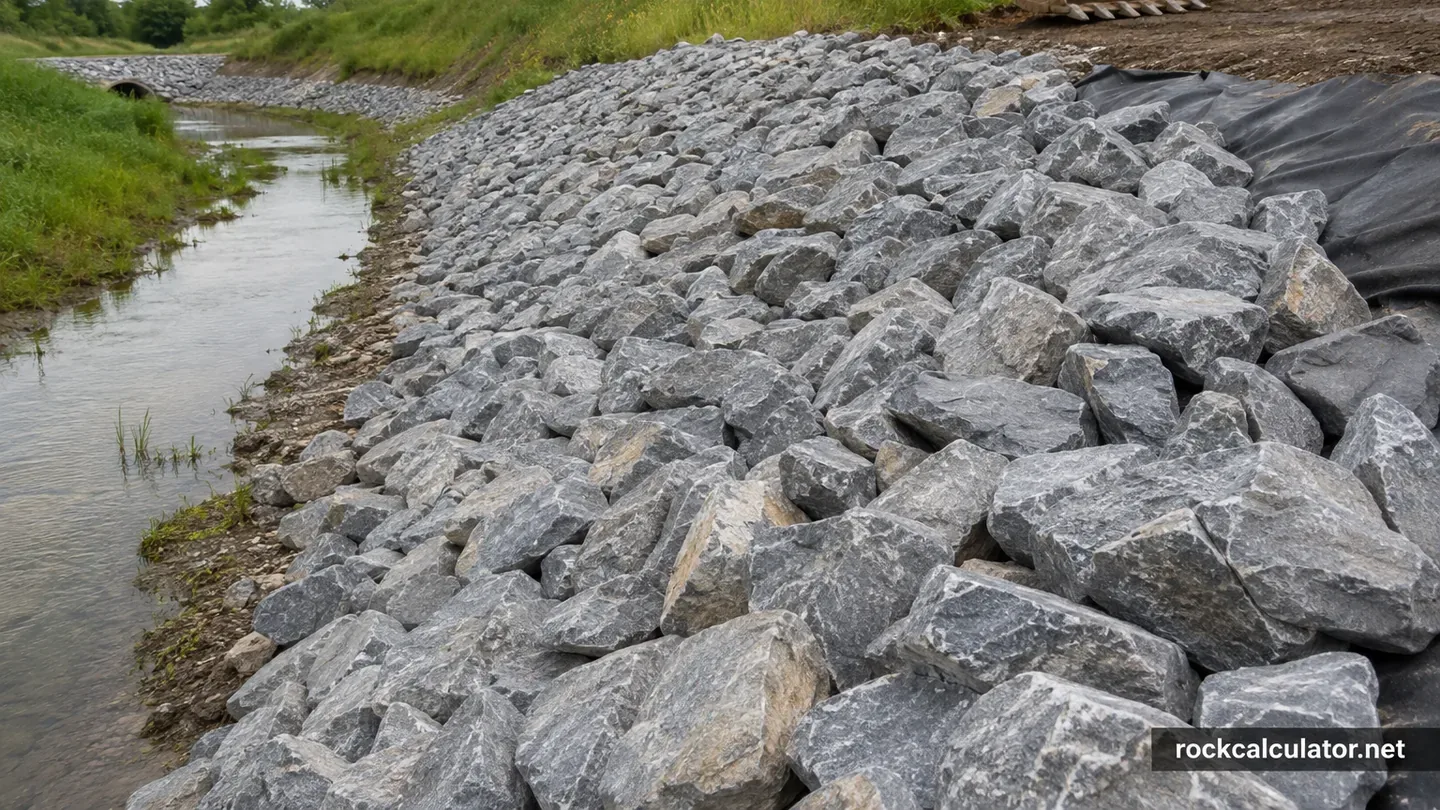
Separate face stone, toe stone, filters, and basket fill
Keep a takeoff line for each zone with its measured geometry, specified stone class, thickness convention, and placement state. Add volumes only when the same product and density basis apply. A filter or bedding layer uses its own thickness and material; including it in the riprap depth would assign it the wrong product and density.
The “6 in+” material label is not a placement-depth instruction. Use the project design for stone size and layer thickness, including the toe and transitions. Where the design uses wire baskets, use the Gabion Stone Calculator for basket dimensions and quantities, and follow the selected basket manufacturer's stone-to-mesh requirements.
Worked riprap example
Example values: 40 ft × 8 ft × (12 in ÷ 12) ÷ 27 = 11.85 yd³ measured volume. With 15% allowance, the order volume is 13.63 yd³. At 1.8 short tons/yd³, the estimated weight is 24.53 short tons. These are examples only; use project measurements and supplier data.
Slope-face length and normal thickness
A sloped bank is longer along its face than its horizontal plan run. For a straight cross-section, slope-face length = √(horizontal run² + vertical rise²). When a specification states that riprap thickness is measured normal to the slope, enter that normal thickness—not a vertical depth. The Bureau of Reclamation riprap design standard defines this thickness convention; the project design still controls stone class, bedding, filter, and toe details.
Slope takeoff example: a 40 ft bank with a 12 ft horizontal run and 5 ft rise has a 13 ft slope face. At 18 in thickness normal to the slope, the face volume is 40 × 13 × 1.5 ÷ 27 = 28.89 yd³. A separate 40 ft × 2 ft × 2 ft toe trench adds 5.93 yd³, for 34.81 yd³ before any stated allowance. Keep the toe as its own takeoff line so its geometry is visible.
Volume, density, and supplier units
Use tons for quarry ordering and confirm that the specified stone class, filter layer, delivery access, and placement equipment match the project.
Field conditions that change tonnage
Large angular rock leaves voids; quarry gradation, layer thickness relative to stone size, slope, toe trenches, bedding, and placement method affect tonnage.
Questions specific to this calculation
Which bulk density belongs in the riprap tons estimate?
Measure the actual protected slope-face area and use thickness normal to the slope when the specification requires it. Enter a bulk density for the specified riprap class and the same placed state as the calculated volume; a loose delivered density needs a documented yield conversion. Calculate toe, bedding, and filter zones separately.