
Count baskets before converting to tons
A bed-coverage estimate starts with surface area and depth. A gabion order starts with the basket schedule: fill length, width, height, and the number of identical baskets. Add a separate row for every size. For stepped arrangements, count the actual baskets in each course; a rectangular envelope around the whole wall includes space that may never contain stone.
Use the basket manufacturer's fill dimensions or specified capacity. This tool treats each row as rectangular fill space. For tapered or irregular units, obtain their specified capacity rather than using maximum outer dimensions. Mesh wire, bracing, overfilling and placement details are not automatically deducted or added.
Calculation and material state
Installed basket volume = sum of length × width × fill height × basket count
Supply volume = installed volume × documented supply ratio × (1 + extra allowance / 100)
Supply weight = supply volume × matching-state bulk density
A cubic yard of hand-packed basket fill and a cubic yard of tipped loose stone may contain different amounts of rock. Leave the ratio at 1 only when the quantity and density use the same basis. If the supplier gives a loose-delivery conversion, enter that ratio and record its source. Bulk basket-fill density already includes spaces between stones; do not substitute solid mineral density or deduct voids a second time.
Worked basket schedule
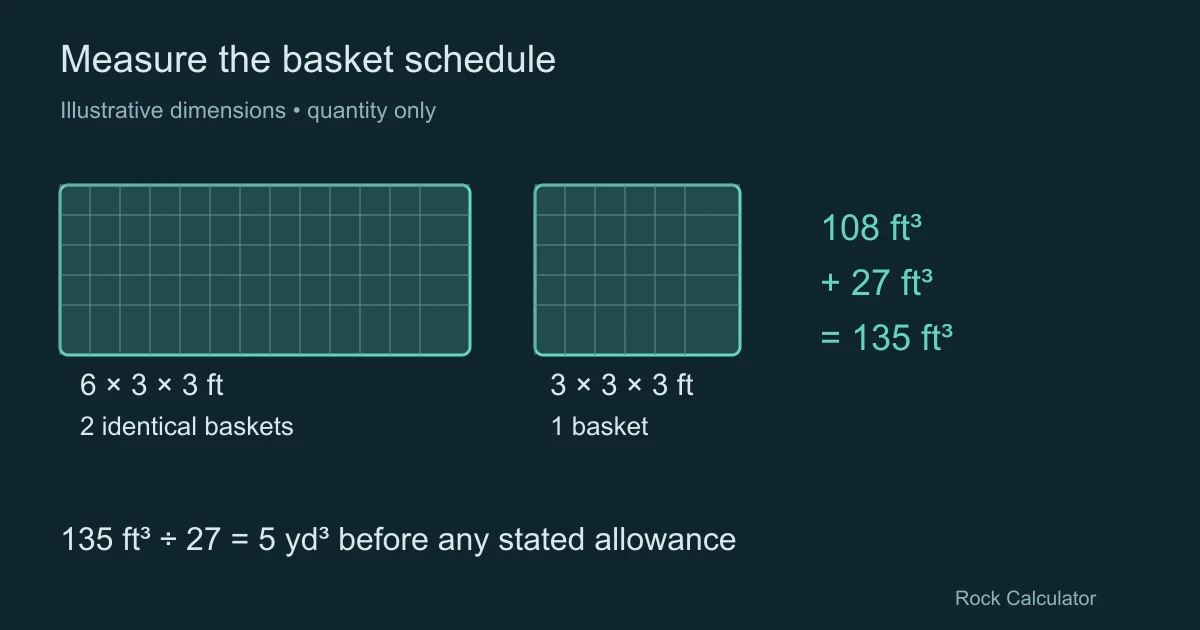
Illustrative inputs: two 6 ft × 3 ft × 3 ft baskets plus one 3 ft × 3 ft × 3 ft basket. Their total is 108 + 27 = 135 ft³, or exactly 5 yd³ (3.823 m³). With a supply ratio of 1 and an explicitly chosen 10% extra allowance, the order is 5.5 yd³ (4.205 m³). These are the values loaded by the example button; no weight is assumed.
If a supplier documents 1.70 US short tons per cubic yard for that same volume state, 5.5 × 1.70 gives 9.35 short tons. This density is an arithmetic illustration, not a supplier quote or a verified value for your stone.
Match the fill to the selected basket system
Confirm the stone grading, durability, shape and mesh compatibility with the basket supplier. Gabion1's tender specifications connect rockfill dimensions and packing requirements to its specified mesh. Those requirements belong to that system; they are not a universal grading for every basket.
The calculator does not choose basket wire, mesh size, bracing, foundations or wall dimensions. It does not check retaining-wall stability, hydraulic forces or erosion protection. Use it to order a quantity after the relevant system requirements have been established.
Confirm what a supplier unit contains
Ask whether the price is per loose cubic yard, per metric cubic meter, per US short ton, per metric tonne, or per package with a stated net weight. A product named a “bulk bag” is not necessarily one tonne or one cubic yard. Enter its actual weight or volume when provided. Confirm minimum orders, delivery access and any separate facing-stone requirement. If facing and core products differ, calculate and save separate estimates for each.
Related stone quantities
For loose erosion-control stone outside baskets, use the riprap calculator. For clean or graded aggregates, see crushed stone. The calculation methodology explains density states and unit conversions.
Unit basis: 1 yard = 3 feet; 1 foot = 0.3048 m; 1 liter = 0.001 m³; 1 US short ton = 2,000 lb. NIST conversion tables support unit conversions, not any product density. Browse all material and project calculators.