
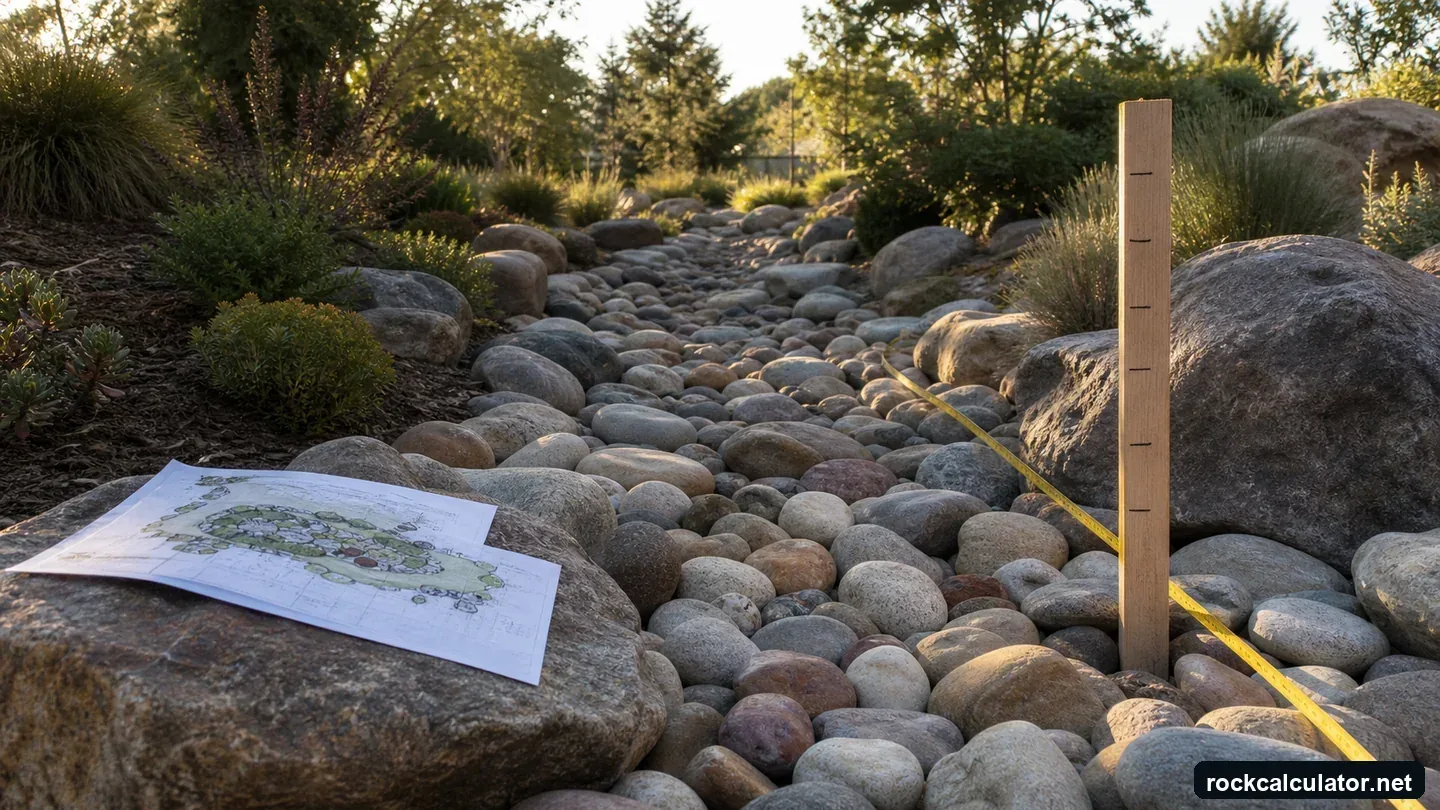
What this river rock calculator returns
Quick answer: Estimate rectangular coverage, cubic yards, short tons, bags, and optional cost for decorative river-rock beds, swales, borders, and water-feature areas.
Measure the contained bed at its finished boundaries and choose a depth that covers the substrate without burying adjacent features. Large cobbles may require a layer depth related to particle size rather than a thin uniform cover.

Formula used by the calculator
Installed cubic feet = length × width × (depth in inches ÷ 12)
Installed cubic yards = cubic feet ÷ 27
Base short tons = cubic yards × density for the same material state
Recommended short tons = base short tons × (1 + stated allowance ÷ 100)
River-rock source basis: unit conversions follow NIST. USACE open-channel guidance distinguishes rounded from angular stone in hydraulic applications; this calculator therefore does not treat decorative river rock as engineered riprap. Supplier bulk density still governs ordering weight. Method and limits.
On the River Rock Calculator, estimated cost equals recommended short tons multiplied by the entered price per ton. Bag count converts recommended tons to pounds, divides by the selected bag weight, and rounds upward. Coverage is length multiplied by width; depth is still required before area becomes volume.
Density is an editable conversion, not a universal constant
The page opens with 1.6 short tons per cubic yard as an example density for river rock. Rounded river rock contains open voids and does not form a compacted structural base. Stone size distribution, moisture, source, and whether the product is washed all influence bulk density and visible coverage.
If a supplier provides a different tons-per-yard figure, first check whether it describes the installed bed or loose delivered river rock. Use it directly only when the material states match; otherwise obtain a documented yield conversion. Solid-stone density cannot stand in for bulk rock with voids between particles.
Stone size, irregular beds, and package yield
Specify the size range as well as the product name. The 3–5 in river-rock option belongs to the same material family, but a shallow layer chosen for small pebbles does not describe a bed of larger cobbles. Confirm visual coverage using the selected supplier's size and placement guidance; the preset does not choose a suitable depth.
For a curved bed, divide the footprint into measured rectangles, triangles, or short segments. Subtract areas occupied by paving or planters, and calculate sections at different depths separately. For example, an illustrative 12 ft × 5 ft rectangle plus a triangular end with a 4 ft base and 3 ft height has 66 ft² of area. At an independently chosen 3 in depth, its volume is 16.5 ft³, or 0.61 yd³. Choose Direct Volume on the main calculator and enter 16.5 ft³ for this measured total.
Decorative names still need product details
For Mexican beach pebbles, record the actual size range, bag or pallet quantity, and coverage basis. For slate chips, obtain coverage for the supplied chip shape and grading. “White rock” describes appearance and should not be assumed to mean marble chips: ask for the product or mineral identification before applying a density. Keep different products in separate order lines even when they share a color.
Use the label's volume when bags are sold by volume
The bag result above is a weight equivalent for the selected bag size. A label stating cubic feet or liters needs a volume calculation: divide the required volume by the labeled yield, then round up. With an illustrative 0.5 ft³ label and matching placement basis, the 16.5 ft³ bed needs 33 bags before any separate allowance. Do not infer that yield from a 40 lb or 50 lb bag of another stone.
Use the Lava Rock Calculator for lava-rock beds with actual bag-volume or bag-weight inputs. Compare delivery, pallet charges, minimum quantities, and the same finished coverage when choosing between bags and bulk.
Worked river rock example
Example values: 22 ft × 9 ft × (3 in ÷ 12) ÷ 27 = 1.83 yd³. At 1.60 short tons/yd³, base weight is 2.93 short tons; with 10% allowance, the example order is 3.23 short tons. Replace these values with project and supplier data.
Turn the result into an order
Use volume to plan the bed and supplier density to estimate delivery weight. For mixed sizes, separate areas when the large-stone layer and smaller bedding or infill layer are purchased independently.
Compare the proposed layer with the largest particles in the quoted size range: a 2 in layer cannot form a uniform profile from 3–5 in cobbles. Measure decorative swales in changing-width segments, and keep any hydraulically designed erosion-control zone separate for the riprap takeoff and professional design checks.
Common river rock estimating errors
- Choosing a depth shallower than the nominal stone size, which can leave incomplete visual coverage.
- Counting a sloped or curved bank as a flat plan rectangle.
- Treating decorative river rock as a compactable driveway or paver-base material.
Questions specific to river rock
Should river-rock depth match the stone size?
Particle size is an important visual-coverage check. A layer thinner than the larger stones cannot behave as a uniform bed, so confirm the intended installed profile with the supplier or designer.
Why is my supplier's river-rock weight different?
Bulk density varies with size distribution, void space, moisture, and quarry source. Replace the example density with the supplier's value for the quoted product.
Can this calculator estimate a dry creek bed?
It can estimate rectangular zones. Measure the bed in segments where width or depth changes, and have erosion-control or high-flow sections sized for site hydraulics rather than quantity alone.
Does river rock need a compaction allowance?
Rounded rock generally settles and rearranges rather than compacting like dense-graded angular base. Use a factor only when it describes the actual installation and supplier guidance.