
Guides / Driveway Gravel
How Much Gravel Do I Need for a Driveway?
Reviewed: September 24, 2026
A driveway estimate is most useful when every layer is measured separately. Area and depth produce volume; supplier density converts that volume to short tons; a stated allowance produces the order basis.
The calculation in one line
Installed cubic yards = length × width × (installed depth in inches ÷ 12) ÷ 27
Matching-state short tons = installed cubic yards × bulk density for that installed state
Order tons = matching-state tons × (1 + defined field allowance percentage ÷ 100)
Reference basis: fixed unit conversions follow the NIST SI conversion tables. Bulk density is product- and condition-specific; the FHWA Field Materials Manual documents aggregate sampling and moisture-density testing; supplier or project data for the actual product and condition should replace the planning preset when available. The USGS aggregates program is used for aggregate terminology and scope. Read the full methodology and limitations.
Length and width describe the finished footprint. Depth describes one installed aggregate layer. If the driveway has a base course and a surface course, calculate them as two materials rather than adding their depths and applying one density.
Worked driveway quantity example
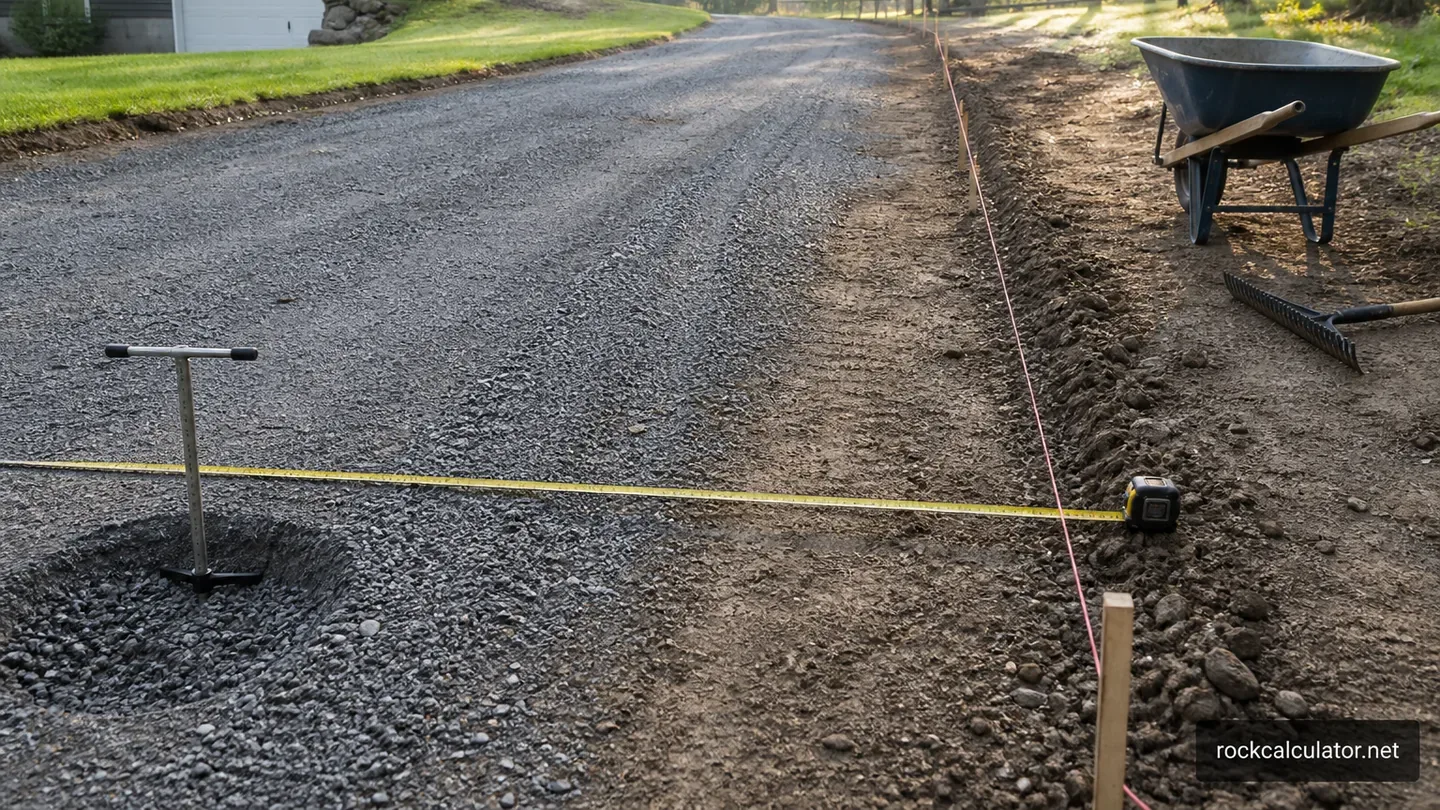
A 68 ft by 11.5 ft lane covers 782 ft². At a 4 in installed depth, its volume is 782 × (4 ÷ 12) = 260.67 ft³, or 9.65 installed yd³. If the entered 1.35 short tons/yd³ density describes that installed state, the base estimate is 13.03 short tons. An 8% stated field allowance produces 14.08 short tons before supplier rounding.
The arithmetic is exact for a rectangular prism; the density and allowance are assumptions. If 1.35 instead describes a loose delivered yard, do not multiply it directly by the installed volume: first use a documented supplier or specification yield factor to convert installed yards to the density state. Apply whole- or half-ton loading rules only after retaining the unrounded calculation.
Resurfacing is different from rebuilding
| Observed condition | What the quantity calculation can do | What needs a site decision |
|---|---|---|
| Firm existing drive with shallow loss | Measure a surface course at its intended finished depth. | Confirm that the remaining base is sound and drainage still works. |
| Ruts or soft spots | Calculate repair zones separately from the general top layer. | Identify weak subgrade, trapped water, or failed base before covering it. |
| New driveway | Produce separate volumes for each specified course. | Set excavation, geotextile, gradation, thickness, crown, and compaction. |
| Variable width or depth | Split the drive into traceable rectangular segments. | Survey grade where a visual average is not dependable. |
From tons on screen to a delivery order
- Record the material name and gradation from the quote.
- Confirm whether the supplier sells by short ton, cubic yard, or truckload.
- Ask for the product's tons-per-yard relationship and delivery minimum.
- Keep base tons, allowance, and final rounded load as separate values.
- Price delivery, spreading, tax, and equipment separately unless the quote clearly includes them.
Do not add a general “compaction percentage” and a waste percentage without defining both. Installed depth is normally the target after placement; the additional order factor should come from the material, supplier, or specification.
Questions this guide answers
Do I calculate driveway base and surface gravel together?
No. Calculate each course separately because depth, density, gradation, compaction, and price may differ.
Why is my supplier's tonnage different?
The supplier may use a different bulk density, measured area, allowance, moisture condition, or rounding rule. Compare those inputs one at a time.
Should the driveway depth be entered before or after compaction?
Use the specified installed depth. Convert it to a loose order only with a documented material or supplier factor.
Can more surface gravel fix potholes and standing water?
Not by quantity alone. Recurring defects can indicate base, subgrade, grade, or drainage problems that should be corrected before resurfacing.