
Guides / Florida Driveway Cost
Florida Gravel Driveway Cost Planning Guide
Reviewed: September 24, 2026
A Florida gravel-driveway budget should separate aggregate quantity from drainage, grading, base repair, delivery, spreading, and compaction. This guide provides that scope framework without publishing a statewide price claim.
Start with layer quantity, not a price headline
Installed cubic yards = length ft × width ft × (installed depth in ÷ 12) ÷ 27
Short tons = installed cubic yards × density for that same installed state
Reference basis: fixed unit conversions follow the NIST SI conversion tables. Bulk density is product- and condition-specific; the FHWA Field Materials Manual documents aggregate sampling and moisture-density testing; supplier or project data for the actual product and condition should replace the planning preset when available. The USGS aggregates program is used for aggregate terminology and scope. Read the full methodology and limitations.
A 55 ft by 11 ft layer at a 4 in installed depth contains 201.67 ft³, or 7.47 installed yd³. Multiply by a density only if it describes that same state. If a quote instead gives loose delivered density, use a documented yield conversion first; then add a defined field allowance once and apply the yard's load rounding.
Separate the cost scope
| Line item | Quantity basis | Questions to resolve |
|---|---|---|
| Surface aggregate | Area × finished surface depth | Product, density, allowance, and delivery unit |
| Base repair or new base | Separate zones or full-area course | Soft spots, excavation, geotextile, gradation, and compaction |
| Grading and drainage | Contractor scope | Crown, cross-slope, ditches, outlets, culverts, and erosion |
| Delivery and spreading | Loads, distance, access, and service | Dump location, tailgate spreading, waiting, and truck access |
| Labor and equipment | Time or quoted scope | Mobilization, roller, skid steer, excavation, and cleanup |
Why drainage belongs in the estimate
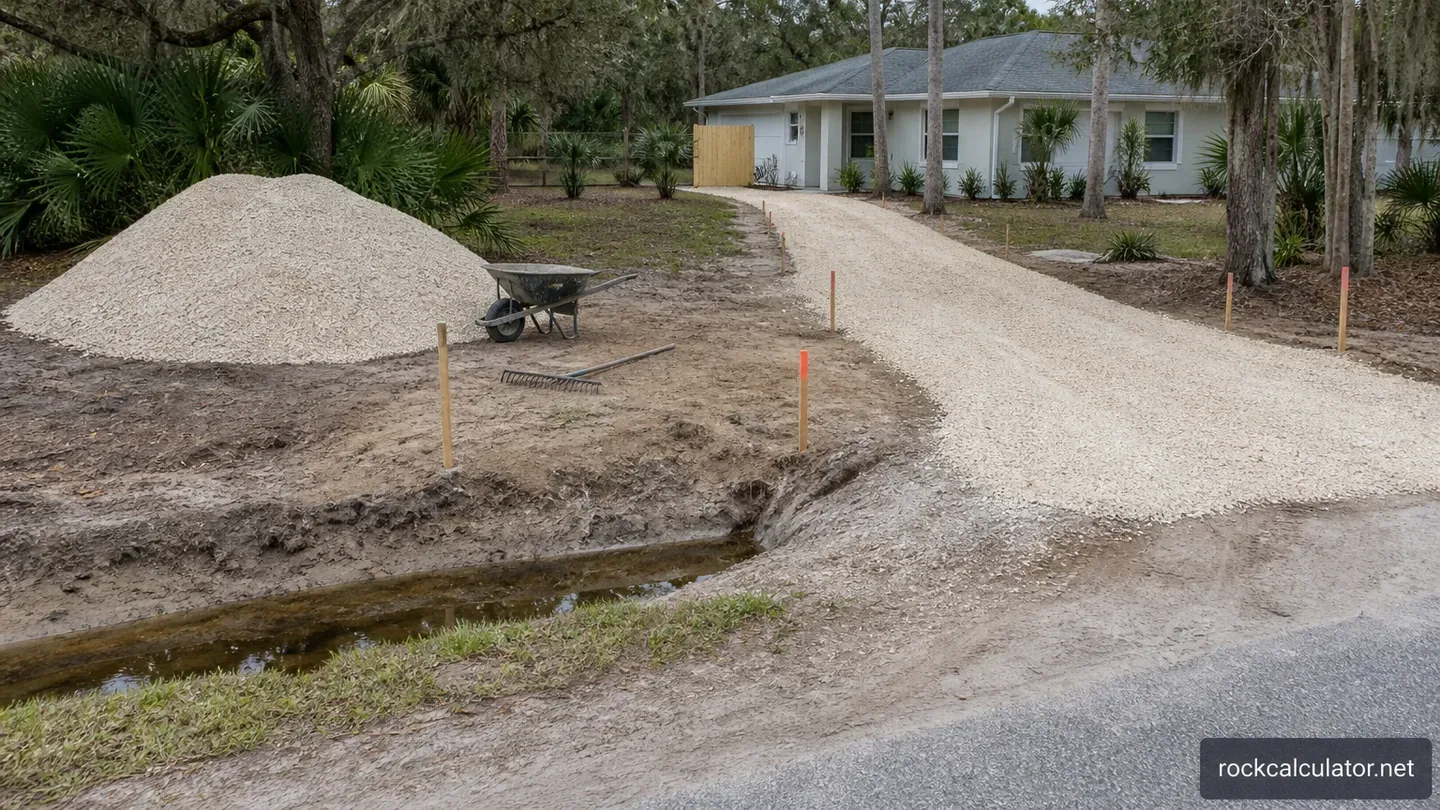
Frequent or intense rain can expose a driveway's low points, blocked outlets, weak shoulders, and soft subgrade. More surface stone does not correct water that has nowhere to go. Before ordering, trace where runoff enters, crosses, and leaves the driveway, then price any grading or drainage correction as its own scope.
Do not infer a universal Florida cross-slope, culvert, or permit rule from this guide. Site elevation, soil, flood conditions, road connection, local jurisdiction, and project type require current local information.
Compare current quotes on the same basis
- Give each supplier the exact product and job address.
- State required short tons or cubic yards and ask how the yard rounds loads.
- Confirm delivery, tax, minimum load, waiting time, and placement service.
- Ask the installer which base or repair quantities are included.
- Keep any drainage, grading, fabric, and compaction work outside the bare material subtotal unless explicitly included.
Questions this guide answers
Does the calculator show the full installed driveway cost?
No. It can estimate material quantity or a user-entered material subtotal. Drainage, grading, base work, delivery, labor, equipment, tax, and permits require separate scope.
Can I fix a wet or rutted driveway with a new top layer?
Not reliably. Recurring water or deformation may require grade, outlet, base, or subgrade correction before resurfacing.
How much extra aggregate should I add?
Estimate known repair zones separately, then use a stated residual allowance supported by the contractor or supplier. Avoid a generic percentage that double-counts compaction.
Are Florida driveway rules the same statewide?
No assumption should be made from this guide. Confirm current requirements with the relevant local authority and project professionals.