
Measure separate beds and exclude occupied areas
Add a row for each bed with a different shape or depth. For an irregular bed, divide it into measured rectangles or enter the total measured area. Exclude pavement, large plant openings and other areas that will not receive rock. Avoid counting the same corner in two rows. An uneven bed can be split into zones at their respective depths.
Choose the installed depth from the intended product and project. The example depth is not a recommendation. Check the supplier's particle-size range and coverage information; large pieces do not behave like a fine, uniform layer.
Read the bag label before using weight
A volume label is the direct basis for a volume order: divide the required supply volume by the volume on each bag. A 0.5 ft³ bag and a 20 liter bag are different package sizes. Enter either in its own units; the calculator converts the units and rounds the final count up.
A bag sold only by weight needs a matching bulk-density value before a coverage estimate can become a bag count. Lava rock is a porous product, so a general gravel or granite density should not be silently substituted. Bag moisture, product grading and packing can also affect the relationship. Weight and volume modes remain separate.
QUIKRETE's published product manual illustrates lava-rock packaging labeled in cubic feet. Product packaging can change; read the current label on the product you intend to buy. The worked example uses an illustrative label, not a live stock or price claim.
Formula and supply conversion
Installed volume = sum of bed area × installed depth
Supply volume = installed volume × documented supply ratio × (1 + extra allowance / 100)
Volume bags = round up (supply volume / labeled volume per bag)
Weight packages = round up (supply volume × matching bulk density / net weight per package)
Use a supply ratio of 1 when bag or bulk volume matches the measured fill basis. If the manufacturer provides a different coverage yield, record the conversion and source. Do not add a guessed compaction allowance solely because another rock calculator includes one.
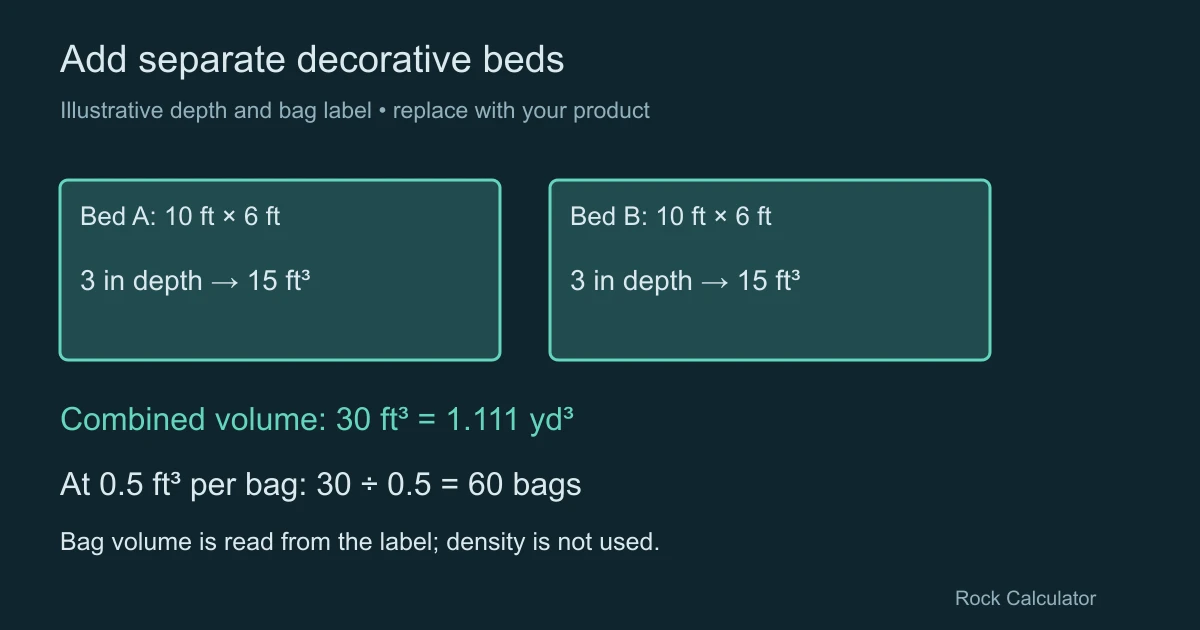
Worked example using two beds
Illustrative inputs: two separate beds, each 10 ft × 6 ft, at 3 in depth. Each bed needs 15 ft³. Together they need 30 ft³ = 1.111 yd³ = 0.850 m³, with supply ratio 1 and no extra allowance. At 0.5 ft³ per bag, buy 60 bags. This calculation does not use a density or assume a 50 lb bag.
Changing the label to 20 liters gives 42.475 bags before rounding, so the purchase count becomes 43. If you add a documented extra allowance, calculate it before rounding; do not round each bed independently when both use the same product.
Bulk delivery and package checks
For a bulk quote, confirm whether the supplier's yard is a loose measured yard and whether a minimum order applies. For bags, check the net volume or weight, particle-size range, number of bags per pallet, delivery fee and return policy. Package count alone does not establish the number of pallets or a truck's payload.
This tool estimates decorative coverage. It does not specify a fire feature, filtration system or drainage design. Use a product explicitly approved for any specialized application.
Compare other decorative materials
Use river rock for rounded decorative stones or pea gravel for smaller rounded aggregate. For soil below or beside the bed, calculate it separately with the topsoil calculator.
Unit basis: 1 yard = 3 feet; 1 foot = 0.3048 m; 1 liter = 0.001 m³; 1 US short ton = 2,000 lb. NIST conversion tables support unit conversions, not any product density. Browse all material and project calculators.