
Measure the layer you still need to fill
For a new layer over existing ground, enter only the additional depth. For a partially filled raised bed measured to its target fill height, enter the full measured space and subtract the volume already occupied within it. Use one approach consistently: measuring only the remaining gap and then subtracting the existing soil again would under-order.
Add separate rows for beds or zones with different depths. An area measurement can replace length and width for irregular beds. Keep units attached to every value, especially when a supplier quotes cubic yards but bag labels use liters.
Topsoil, fill dirt and growing mixes serve different jobs
A topsoil layer is intended to support the planting area; fill dirt is typically ordered for raising or shaping ground. A product sold as garden soil or raised-bed mix may contain different ingredients and have a different yield. Ask for the actual product composition and intended use before using its label or density.
University of Maryland Extension's raised-bed soil guidance advises checking the source, handling and soil-test information when buying topsoil. It also explains that some bagged organic products are mixtures rather than mineral topsoil. Quantity alone does not establish soil quality or suitability for a particular crop.
This calculator does not specify a soil blend, fertilizer rate, structural fill or compaction target. Estimate each separately purchased ingredient on its own basis; a finished blend volume is not automatically the sum of uncompacted component volumes.
Net volume, yield and bags
Net installed volume = sum of (bed area × target layer depth − occupied volume)
Supply volume = net installed volume × documented supply ratio × (1 + extra allowance / 100)
Volume bags = round up (supply volume / labeled bag volume)
The default supply ratio is 1. If the supplier documents that a larger loose volume is needed to reach the target placed volume, enter the ratio and its source. A statement such as “20% settlement” is incomplete without a defined starting and ending volume. For example, if placed volume is 80% of delivered volume, the delivered/placed ratio is 1 ÷ 0.8 = 1.25, not 1.20. Do not add a second allowance for the same effect.
Worked partially filled bed example
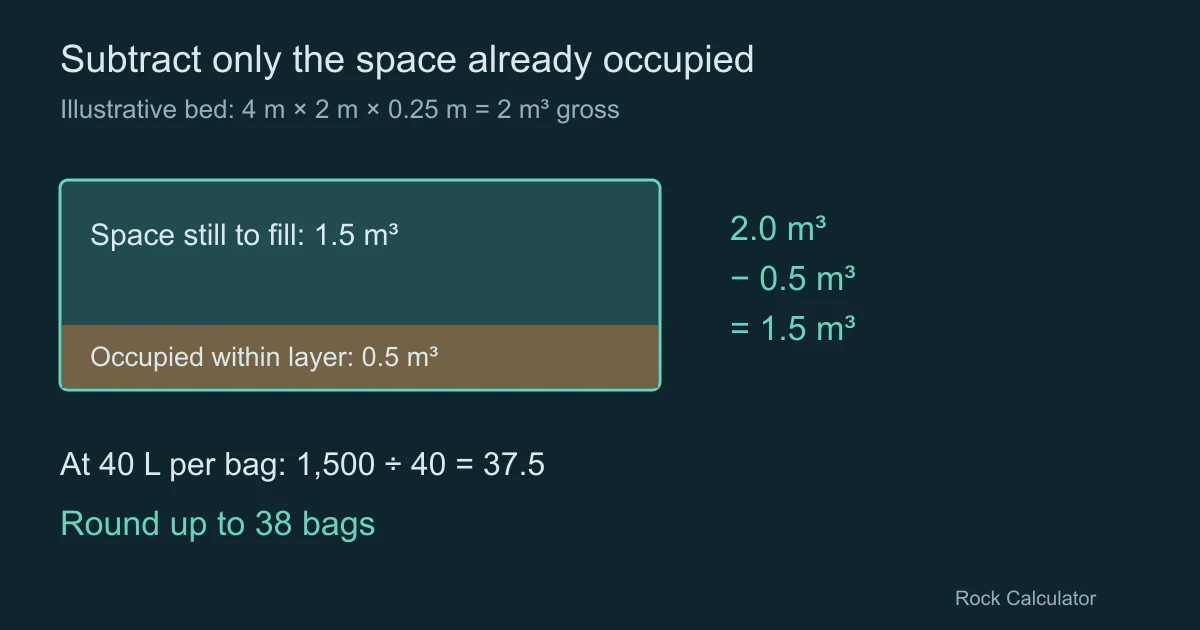
Illustrative inputs: a 4 m × 2 m bed with a measured target layer 25 cm deep contains 2.000 m³ of space. If 0.500 m³ of that measured space is already occupied, 1.500 m³ remains, equivalent to 1.962 yd³. With supply ratio 1 and no extra allowance, 40 liter bags require 1,500 ÷ 40 = 37.5 bags, rounded up to 38. These values are loaded by the example button.
If your own documented supply ratio were 1.20, the supply volume would be 1.800 m³ and the same bags would require 45. The example does not establish that 1.20 is appropriate for your soil.
Estimate weight only with a matching supplier value
Water changes the weight of soil, and screening, composition and handling can change its bulk density. A dry-soil figure cannot be assumed to describe a wet delivery. If the order is sold by weight, record the exact product, supplier, material state, date and units for the density used. Weight is left unestimated until that information is entered.
For volume bags, use the actual labeled volume directly. Do not convert a 40 lb label into liters using a generic topsoil density and treat the result as verified bag yield. The weight-package mode makes that density dependency explicit.
Plan neighboring material layers separately
Keep drainage stone, soil and surface mulch as separate quantities. Use the French-drain tool for a specified stone-filled trench, lava-rock calculator for decorative rock coverage, or the main calculator for the retained fill-dirt, compost and organic-mulch planning presets.
Unit basis: 1 yard = 3 feet; 1 foot = 0.3048 m; 1 liter = 0.001 m³; 1 US short ton = 2,000 lb. NIST conversion tables support unit conversions, not any product density. Browse all material and project calculators.