
Sand Calculator Tool Overview
In any construction, sand is among the most important components used to make blocks, pillars and many more. However, it is important to know and calculate the exact amount needed for the project to be completed on time without any interruption. If you order excess sand, it increases the production cost but if you order less, then it will slow down construction. Therefore, we have developed a modern and unique calculator that will estimates the exact amount required to complete the project on time. The name of our calculator is Sand Calculator which analyzes the dimensions entered by the user to get accurate calculations
In this article we will explore the sand calculator in detail, and we will talk about all the key features it provides. Moreover, we will explain all the different measures it offers for the convenience of users. Our Sand Calculator works just like the rest of the tools on the main Rock Calculator tool, providing accurate results for construction and landscaping projects.
What is Sand Calculator?
The Sand Calculator is a modern online calculator developed to accurately calculate the amount of sand needed for a specific project. It uses the length and width of the project users have entered. Afterwards, it applies different formulas to get the exact results in a few seconds. It provides estimations in multiple measurements like kilograms and tons. This makes it easy for the buyers to choose according without wasting resources and time. Another important fact about this calculator is that if you have sand and want to know how much area will be covered by that amount. All you have to do is to enter the amount of sand there is, and this calculator will calculate volume and convert it into cubic meters and square feet. Our sand calculator works just like our Granite Calculator and Limestone Calculator, which also help estimate materials based on project dimensions.
The calculator is simple to use, and it has an effective interface that makes navigation so easy that anyone can use it with zero difficulty. In addition, the menu provides multiple options of measurements making construction work easier and more efficient.
Using a Sand Calculator for Square Feet
Square feet are the standard measurement of area in modern world; most houses and patios use this measurement. Therefore, you can use our calculator to accurately calculate the required amount of sand for the project. For similar surface-based calculations, you may also try our Gravel Calculator which is commonly used for patios, paths, and landscaping projects. To get the precise results our calculator does the following things. Firstly, it measures the length and width of the project provided by the users. It also measures depth, since sand is usually used for filling. Lastly, after doing all the steps and calculating, it gives result in square feet. You can also estimate materials like pea gravel using our Pea Gravel Calculator for landscaping bases and decorative areas.
Sand Calculator for Circular Areas
Circular areas are a bit tricky because unlike squares or rectangles, they do not have length and width instead we must work with diameters and radius. When users enter the exact radius or diameter our calculator quickly calculates the area and provides the estimations in no time.
Example:
A circular area with a radius of 5 ft 4 in is calculated like this:
This feature is extremely helpful for landscaping and decorative construction.
Sand Calculator in Tons
For large-scale projects, the contractor requires huge amount of soil mostly measured in tons. Projects like building roads, skyscrapers and many more require a lot of sand. Therefore, to get the correct estimation our sand calculator converts cubic yard of sand into tons for better results. To make sure these readings are accurate our calculator takes the density of sand into account. If your project requires converting densities for other materials, our River Rock Calculator and Crushed Stone Calculator also provide ton-based calculations.
1 cubic yard of sand is almost equal to 1.3 to 1.5 tons
So, you see using a calculator is beneficial as to get the results on time and saves contractors from converting such high values manually reducing the chances of error and miscalculations.
Sand Calculator in Bags
In many small projects contractors need sand in 40 lb, 50 lb, and 80 lb bags but they are unsure of the exact amount required. So, to help with this scenario our calculator does three things. Firstly, it analyzes the volume of the sand required for the project and of course by considering the sand’s density. Secondly, after analyzing the parameters provided by the users it gets the accurate number of bags required for the project. Lastly, by multiplying the number of bags with the current cost it estimates the total project cost.
This process can be done manually but it requires a lot of time, energy and money making it hard for contractor and by using the calculator they can get the work done in seconds.
Sand Calculator Yards
When the delivery of sand comes the contractors measure sand in cubic yards as it is simple after calculating density and other factors. So, what our calculator does is convert volume in yards to square feet.
1 cubic yard = 27 cubic feet
This makes ordering and delivering heavy materials easy and feasible.
Why Use a Sand Calculator?
There are numerous reasons why we should use sand calculator? There are many reasons to use the sand calculator. Firstly, it provides the best and clearest estimations in a matter of seconds for free. Secondly, it reduces human effort and manual labor as we know it requires a lot of research to complete this by hand. Lastly, this tool offers multiple measurement options for users’ convenience. Overall, this is an excellent tool that gives results and protects users from unnecessary hassle. For a more detailed understanding of material measurements and landscaping materials, you can also visit our Rock Calculator Guide.
How Much Sand Do I Need?
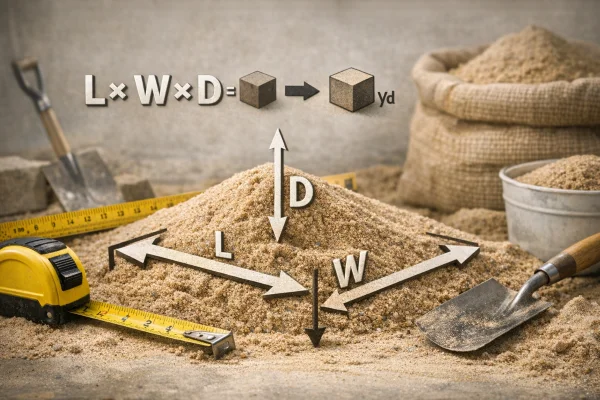
If you’re trying to figure out how much sand you need, the easiest way is to measure your project area and multiply the length, width, and depth. Then convert the result to cubic yards, since that’s how most suppliers sell sand. As a rule of thumb, add a little extra—around 5 to 10 percent—to cover settling and uneven surfaces. This simple approach helps you order the right amount without overspending or running short in the middle of your project.
Quick method (one formula)
-
Measure the area: length (ft) × width (ft).
-
Convert depth to feet: depth (in) ÷ 12.
-
Volume in cubic feet = length × width × (depth/12).
-
Convert to cubic yards (how suppliers usually sell): cubic feet ÷ 27.
-
Add 5–10% for waste/compaction and round up when ordering.
Why cubic yards?
Suppliers normally sell by the cubic yard. If you need weight (tons), typical dry sand weighs about 2,700 lb per cubic yard, so:
-
tons = cubic yards × 2700 ÷ 2000 ≈ cubic yards × 1.35
Handy examples
-
10 ft × 12 ft slab, 4 in deep
-
Volume = 10 × 12 × (4/12) = 40 ft³ → 1.48 yd³ → ~2.0 tons
-
-
20 ft × 20 ft patio, 2 in sand base
-
Volume = 20 × 20 × (2/12) = 66.67 ft³ → 2.47 yd³ → ~3.3 tons
-
-
Sandbox 6 ft × 4 ft, 12 in deep
-
Volume = 6 × 4 × 1 = 24 ft³ → 0.89 yd³ → ~1.2 tons
-
Practical tips
-
Depth guidance:
-
Paver base sand — typically 1–2 in.
-
Bedding for concrete/mortar — usually 3–4 in depending on project.
-
Play sand in sandbox — often 8–12 in.
-
-
Compaction & settling: Add 5–10% extra for compaction, uneven ground, and waste. For heavy compaction (road base, structural fills) you may need more—ask the supplier or contractor.
-
Check density: Different sands vary (play sand, masonry sand, pit sand). If you need a very precise weight, ask your supplier for the sand’s density or weight per cubic yard.
-
Ordering tip: Suppliers often sell by the ton or by the cubic yard — tell them the cubic yards you need and they’ll convert.
Conclusion
To conclude, the sand calculator is an excellent tool that not only calculates the amount of sand required for a project but also area where contractors can use it. It has simple menu and offers different measurement like square feet and cubic feet. Overall, our calculator is an excellent tool and everyone should use it to get better results.
If your project involves additional materials, you can also check out our Granite, Limestone, and Pea Gravel calculators for accurate estimates.
FAQs
How can I use the sand calculator?
Using sand calculator is simple, you need to enter the accurate dimensions like length, width, and depth for accurate calculations.
How is it different from regular calculators?
It is different in many ways; regular calculations only solve simple math problems. However, our calculator is designed especially for sand measurements.